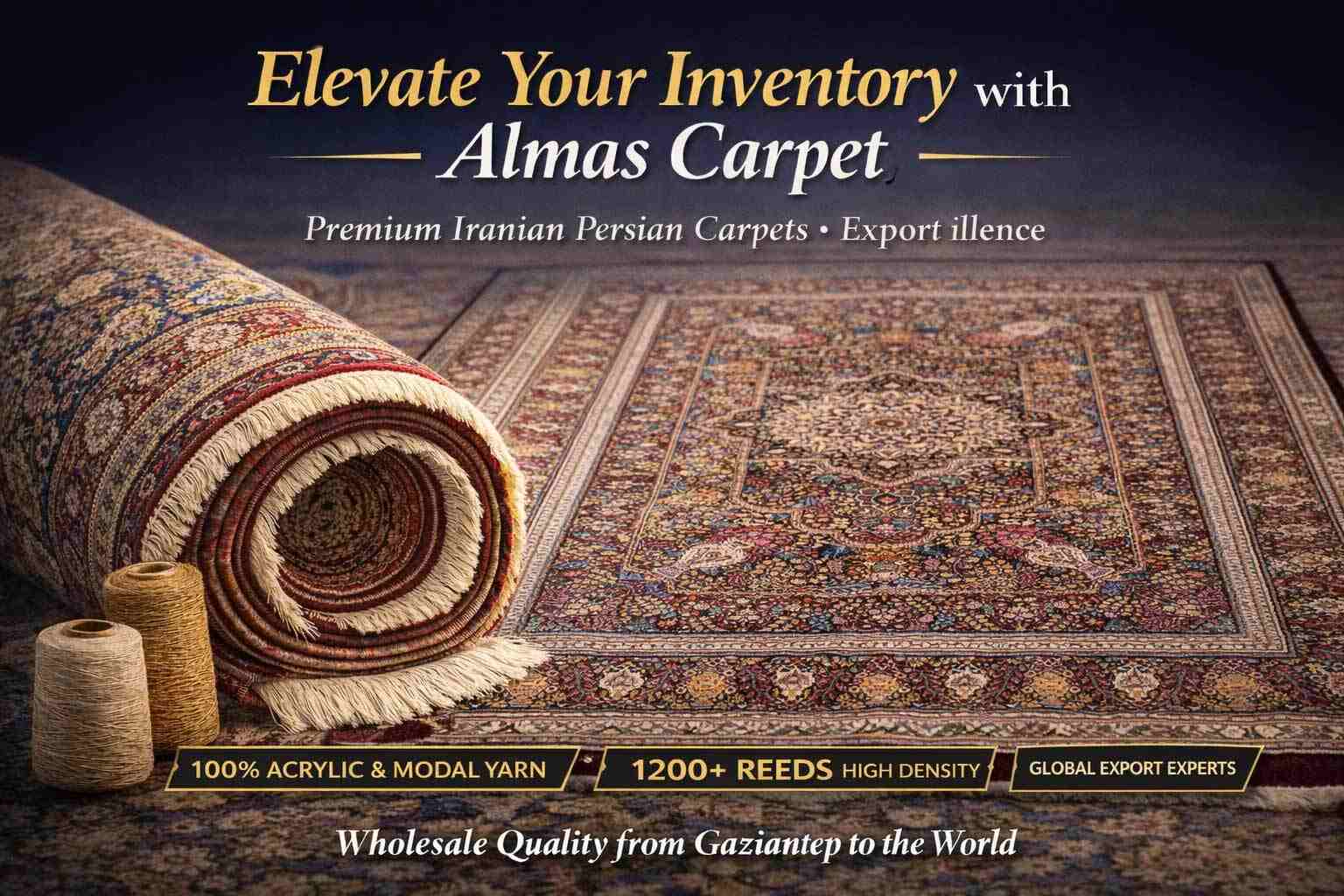
In the high-stakes arena of global textile trade, two giants dominate the machine-made carpet industry: Iran and Turkey. For international wholesalers, interior designers, and retail distributors, the choice between these two origins is rarely simple. It is a strategic decision that impacts your inventory turnover, brand reputation, and bottom-line profitability.
As a B2B buyer, you likely face the same dilemma: Is Iranian or Turkish carpet better for your specific market? Do you prioritize the volume and aggressive pricing of Turkish manufacturing, or do you invest in the heritage, high-density, and margin-rich potential of Kerman rug?
At Almas Carpet, we believe in transparency. This comprehensive guide moves beyond surface-level aesthetics to provide a technical and economic comparison of Iranian vs. Turkish carpets, helping you make an informed decision for your 2026 inventory.
HAPPENING NOW: Experience the Almas difference at Istanbul Carpet Fair (Jan 6–9). Visit us at Hall 1, Booth 125B to discuss exclusive wholesale rates and territory rights.
The Geography of Weaving: Why Origin Matters for Carpet Exports
While modern machinery—primarily Van de Wiele looms—is used in both countries, the philosophy of production creates a stark divide.
Turkey: The Mass Production Powerhouse
Turkey has positioned itself as the logistical hub of Europe. Their carpet industry is built on speed and accessibility. Turkish manufacturers often utilize polyester and polypropylene (PP) blends to keep costs low.2 This makes Turkish rugs an excellent choice for big-box retailers, but it often sacrifices the long-term durability that premium clients demand.

Iran: The Intersection of Heritage and High-Tech Manufacturing
Iran approaches machine-made carpets as a cultural ambassador. The goal is to produce a machine-made rug that rivals a hand-knotted masterpiece. By slowing down the weaving process, Iranian manufacturers like Almas Carpet achieve ultra-high densities (1,200–1,500 reeds) using premium heat-set acrylic that mimics natural wool.
Do you want to collaborate with the best wholesale carpet supplier in Turkey? Fill out the form below, and our sales team will review your request and get back to you.
1. Quality and Construction: Is Iranian or Turkish Carpet Better?
For the technical buyer, the “Hand” and the “Specs” are everything. Here is the technical comparison of the two origins.
Fiber Composition and Material Science
- Turkish Standard: Predominantly Polyester or Polypropylene. These are shiny but prone to “piling” and flattening under heavy traffic.
- Iranian Standard (Almas Carpet): 100% Heat-Set Acrylic. This is the gold standard for export-quality carpets. It is resilient, UV-resistant, and maintains its pile height for decades, offering a far superior tactile experience than Turkish synthetics.
High Density Benchmarks: Reeds and Picks
The density determines the clarity of the design and the rug’s weight.
- Turkey: Average density ranges from 320 to 700 reeds. The weave is looser, making the rug lighter.
- Iran: Almas Carpet specializes in 1,200 and 1,500 reed collections.3 This creates a “Hand-Look” finish where the design detail is photo-realistic, a key selling point for luxury rug retailers.
2. Price vs. Profitability: The Wholesaler’s Margin Equation
When comparing Iranian vs. Turkish carpet prices, remember: Price is what you pay; value is what you get.
2026 Market Wholesale Benchmark (Standard 5×7 ft Rug)
| Feature | Turkish Machine-Made (Avg.) | Iranian Machine-Made (Almas Premium) |
| Wholesale Sourcing Cost | $100 - $200 | $150 - $250 |
| Fiber Quality | Polyester / PP | 100% Heat-Set Acrylic |
| Reed Density | 500 - 700 Reeds | 1,200 - 1,500 Reeds |
| Retail Markup Potential | 2.0x - 2.5x | 3.0x - 4.5x |
| Lifespan & Durability | 3 - 7 Years | 15 - 25 Years |
| Wholesale Margin | Standard | High (Premium Segment) |
The "Almas" Advantage in Export Margins
Why do Iranian rugs command a higher markup? It comes down to Perceived Value. The weight, the density, and the authentic Persian designs justify a luxury price tag. Selling one Almas carpet often nets the same profit as selling three standard Turkish rugs, with significantly lower return rates
3. Design Philosophy: Authentic Persian Motifs vs. Fast-Fashion
In the world of carpet exports, authenticity sells.
- Turkish Design Strategy: Turkey excels at “Fast-Fashion.” They follow European trends (minimalism, grey-scale) quickly. However, these designs often lack depth and can feel repetitive across different brands.
- Iranian Design (Almas Approach): We draw from 2,500 years of heritage. Our 1,500-reed carpets utilize up to 15 distinct colors, allowing for intricate floral curves and “distressed antique” looks that Turkish looms simply cannot replicate with lower densities.
4. Durability and Resilience: Built for High-Traffic Luxury
Whether supplying a hotel or a high-end residence, durability is the ultimate trust builder.
- Heat & Wear Resistance: Almas Carpet’s acrylic piles pass the “iron test”—they do not melt under indirect heat, unlike Turkish polypropylene.
- Hygiene and Maintenance: Iranian acrylic is inherently anti-bacterial. Our use of high-grade latex and jute ensures the rug stays flat, preventing the “corner curling” often seen in cheaper Turkish imports.
5. Logistics and Supply Chain: Sourcing Iranian Carpets Safely
A common query for B2B buyers is the ease of carpet exportation from Iran. At Almas Carpet, we have streamlined this to match global standards:
- Global Shipping Hubs: We utilize established routes via sea, air, and land to ensure timely delivery to Europe, Asia, and the GCC.
- Customs & Compliance: Our team handles all Certificate of Origin and ISO 9001 documentation, ensuring a seamless customs process at your port.
- Secure B2B Payments: We offer transparent payment channels tailored for international wholesale transactions.
Why Partner with Almas Carpet for Your Inventory?
Choosing Almas Carpet means choosing Topical Authority in the textile industry. We are not just manufacturers; we are partners in your growth.
- The Elegant VX Collection: The pinnacle of 1,500-reed luxury.
- The Graph Collection: Bridging the gap with modern architectural designs.
- Quality Consistency: We guarantee that every shipment matches the sample quality—no exceptions.
FAQ: Iranian vs. Turkish Carpet Comparison
1. Why is the price of Iranian carpets higher than Turkish ones?
The price reflects the Material Science (Heat-set Acrylic vs. Polyester) and the Density (1500 Reeds vs. 700 Reeds). Iranian rugs are an investment in durability and high-margin retail.
2. Is it difficult to export carpets from Iran to Europe or the GCC?
Not with a professional partner. Almas Carpet handles all logistics, insurance, and customs documentation, providing a “Door-to-Door” feel for our international buyers.
3. Which is better for high-traffic areas, Iranian or Turkish?
Iranian acrylic carpets are significantly better for high-traffic zones due to their “fiber memory” and resilience. They do not flatten or lose their shape over time.
4. Can I get exclusive designs for my region?
Yes. We offer territory exclusivity for wholesalers who meet certain volume benchmarks. Visit our booth at ICFE 2026 to discuss terms.